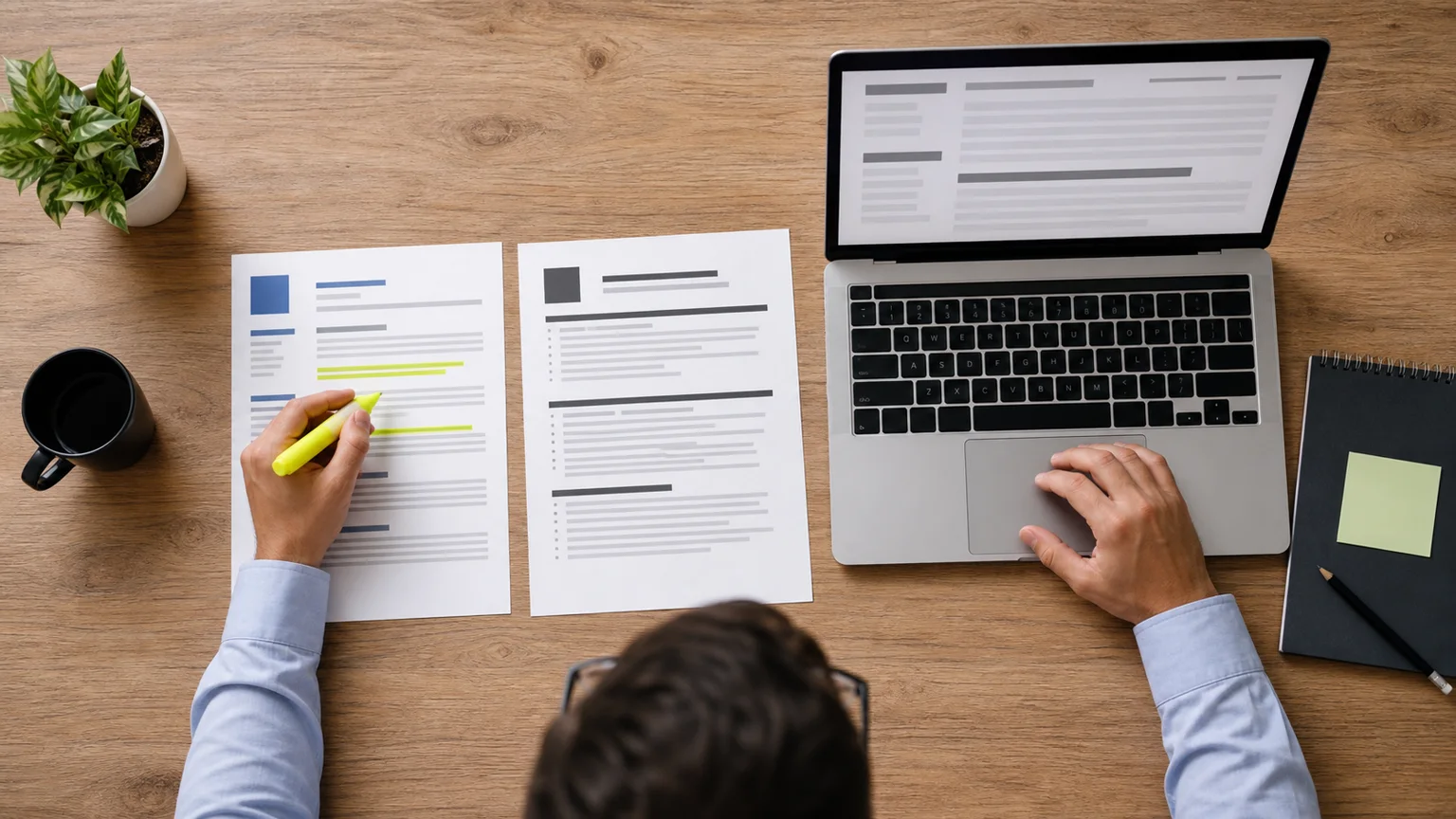
A job interview is both an assessment and a chance for the candidate to learn whether the role fits. Preparation cannot guarantee an offer: hiring decisions can depend on the applicant pool, employer process, role requirements, references, budget, and factors a candidate cannot observe. Preparation can still improve the quality and relevance of the evidence you present.
This guide draws on interview material from the U.S. Department of Labor (DOL), the U.S. Office of Personnel Management (OPM), and the Equal Employment Opportunity Commission (EEOC). Employment practices and applicant rights differ by country, state, and role, so jurisdiction-specific sections are labeled accordingly.
1. Convert the Job Description Into a Requirements Map
Read the posting again and identify the requirements that appear central rather than copying every phrase. Create a table with four columns:
- Requirement: the skill, experience, or behavior requested;
- Evidence: one example showing you used it;
- Result: what changed because of your work;
- Gap or question: anything you need the interviewer to clarify.
The DOL recommends researching the organization and position and reviewing the duties, requirements, and evaluation methods. Focus preparation on job-related evidence instead of trying to sound impressive in general.
If the posting asks for stakeholder communication, for example, “I am a good communicator” is weak evidence. A short example showing the audience, problem, action, and outcome gives the interviewer something concrete to evaluate.
2. Research What You Need to Make a Decision
Useful research goes beyond memorizing the About page. Review the employer's official site, the role description, relevant products or services, and credible recent announcements. Write down:
- what the organization appears to provide and to whom;
- where the role sits in that work;
- which claims you still need to verify in the interview;
- what would make the job attractive or unsuitable for you.
Do not pretend to know internal strategy from public material. Turn uncertainty into a question: The posting mentions a migration project. What stage is it at, and what would this role own?
3. Prepare Evidence for Behavioral Questions
OPM explains that structured interviews often ask candidates about relevant past behavior or how they would respond to a job-related scenario. Structured processes use predetermined questions and common rating standards so candidates can be assessed more consistently.
A STAR structure can keep an example focused:
- Situation: the minimum context needed;
- Task: your responsibility or goal;
- Action: what you personally did and why;
- Result: the outcome, evidence, and what you learned.
Prepare a small evidence bank rather than memorizing one answer for each possible question. Include examples of solving a problem, working with others, handling disagreement, learning from a mistake, prioritizing work, and adapting to change. One example may answer several questions when the emphasis changes.
Use metrics only when they are real and explainable. “Reduced processing time from two days to four hours” is useful if you can describe the baseline and your contribution. An invented percentage damages credibility.
4. Practise for Clarity, Not a Scripted Performance
Say your examples aloud. Check whether a listener can identify the problem, your role, the action, and the result without knowing the project already.
A practical rehearsal loop is:
- answer one question without notes;
- time the answer;
- remove background that does not affect the decision;
- add the missing action or result;
- practise a shorter version.
Do not memorize every sentence. A rigid script can become difficult to adapt when the interviewer asks a follow-up or phrases the question differently.
For a remote interview, test the connection, audio, camera, meeting link, and a backup contact method. The DOL also recommends a quiet space with limited distractions. The companion guide on preparing for a remote job interview covers that format in detail.
5. Listen for the Competency Behind the Question
During the interview, listen to the full question and answer what was asked. It is reasonable to pause, request clarification, or ask for the question to be repeated. The DOL advises direct answers supported by examples relevant to the position.
For a broad question such as “Tell me about a difficult project,” ask yourself what evidence the interviewer may need: planning, technical judgment, communication, resilience, or something else. If the question remains ambiguous, clarify rather than guessing.
Avoid turning every answer into the same success story. A credible account can include constraints, an imperfect first attempt, and a specific lesson—provided it still shows how you responded responsibly.
6. Prepare Questions That Help You Evaluate the Role
The interview is a two-way discussion. Questions should help you understand expectations and working conditions, not merely signal enthusiasm. Examples include:
- What would success look like in the first three to six months?
- Which problems would this person own first?
- How is work prioritized when deadlines conflict?
- How does the team review decisions and learn from mistakes?
- Why is the position open?
- What are the next steps and expected timeline?
Questions about compensation, benefits, leave, flexibility, or accommodations are legitimate. The appropriate timing and contact vary by employer and hiring process; avoid the universal rule that candidates should never raise them early. If a recruiter or HR contact owns those topics, ask that person.
7. Handle Difficult or Inappropriate Questions Carefully
For weaknesses, failures, or conflict, choose an example that is honest and relevant. Explain the behavior you changed or the safeguard you added rather than disguising a strength as a weakness.
In the United States, EEOC guidance says pre-employment information should generally be limited to what is essential for deciding whether a person is qualified. Federal law prohibits employers from using protected characteristics in hiring and restricts pre-offer disability inquiries; state and local rules may add protections.
A candidate faced with a personal question can ask how it relates to the role, redirect to their ability to meet the job requirement, or seek jurisdiction-specific advice. A general article cannot determine whether one question is unlawful in every location.
Candidates who need a disability-related accommodation can request one. U.S. EEOC guidance states that covered employers must provide reasonable accommodation to applicants with disabilities unless it would cause significant difficulty or expense.
8. Close and Follow Up
Before the interview ends, confirm the next step and timeline. If you remain interested, say so plainly without claiming the role is perfect before you understand it.
The DOL recommends sending a concise thank-you email. Reference a useful point from the conversation, provide any promised information, and correct an important omission if necessary. A note is professional follow-up, not a tactic that guarantees selection.
Afterward, record:
- questions asked;
- evidence that worked well;
- answers that became vague or too long;
- new facts about the role;
- anything requiring follow-up;
- whether the job still matches your goals.
This turns each interview into data for the next one.
A 30-Minute Minimum Preparation Plan
When time is limited:
- Spend 10 minutes mapping the top three requirements to real examples.
- Spend 8 minutes researching the organization and role from primary sources.
- Spend 7 minutes saying two examples aloud.
- Spend 3 minutes writing three genuine questions.
- Spend 2 minutes checking logistics and contact details.
More preparation may help, but relevance matters more than collecting endless possible questions.
Check Your Interview Knowledge
The Job Interview Skills Quiz checks preparation, behavioral answers, listening, follow-up, and candidate questions. It is an educational knowledge quiz, not a hiring assessment and not a predictor of whether a particular employer will make an offer.
Sources and further reading
- Interview Tips U.S. Department of Labor · Accessed July 31, 2026
- Interview Skills Participant Guide U.S. Department of Labor, Veterans' Employment and Training Service · Accessed July 31, 2026
- Structured Interviews U.S. Office of Personnel Management · Accessed July 31, 2026
- Prohibited Employment Policies and Practices U.S. Equal Employment Opportunity Commission · Accessed July 31, 2026