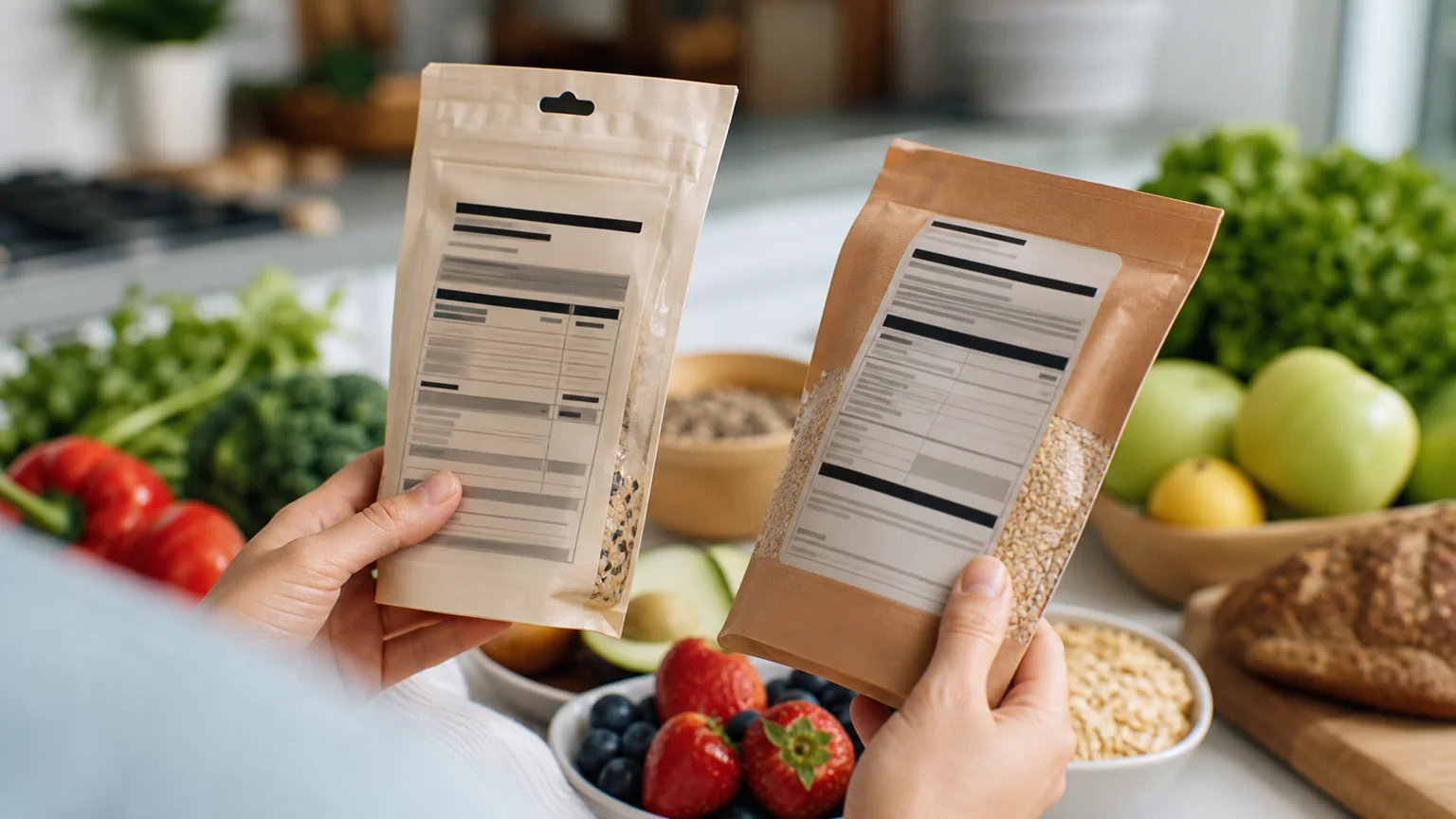
A Nutrition Facts label becomes manageable when you ask a small number of questions in the right order. Start with the serving, adjust for the amount you will actually use, then examine the nutrients relevant to your comparison. The label supplies facts; it does not grade a food as universally good or bad.
This walkthrough uses an invented practice product called Savoury Oat Squares. It is not a real food, brand, recipe, or recommendation. Its numbers were created solely to demonstrate label arithmetic under the current U.S. format. Labels and rules differ by country, and individual nutrition needs differ with age, health, activity, pregnancy, allergies, medication, and other circumstances.
The invented practice label
Imagine the package displays this information:
Nutrition Facts — Savoury Oat Squares (fictional)
- About 8 servings per container
- Serving size: 40 g, about 12 squares
- Calories: 170
- Total fat: 6 g — 8% Daily Value
- Saturated fat: 1 g — 5% Daily Value
- Trans fat: 0 g
- Cholesterol: 0 mg — 0% Daily Value
- Sodium: 230 mg — 10% Daily Value
- Total carbohydrate: 26 g — 9% Daily Value
- Dietary fibre: 4 g — 14% Daily Value
- Total sugars: 6 g
- Includes 4 g added sugars — 8% Daily Value
- Protein: 5 g
- Vitamin D: 0 micrograms — 0% Daily Value
- Calcium: 40 mg — 4% Daily Value
- Iron: 1.8 mg — 10% Daily Value
- Potassium: 180 mg — 4% Daily Value
Invented ingredients: whole-grain oats, chickpea flour, sunflower oil, brown sugar, sesame seeds, salt, dried herbs. Contains sesame.
Nothing about these fictional figures tells you whether this product fits a particular diet or health condition. They give us a consistent object on which to practise.
Minute 1: read the serving before any nutrient
The label says one serving is 40 grams, about 12 squares, and the package contains about eight servings. Every nutrient number below is based on that serving unless the package provides another column.
The U.S. Food and Drug Administration explains that serving sizes reflect amounts people typically eat or drink; they are not recommendations for how much to consume. That distinction prevents two common mistakes:
- assuming one labelled serving is a personal target; and
- reading one serving's numbers while using substantially more or less.
Suppose you plan to eat about 24 squares. That is approximately two servings. For a simple estimate, multiply each amount by two:
- Calories: 170 × 2 = 340
- Sodium: 230 mg × 2 = 460 mg
- Fibre: 4 g × 2 = 8 g
- Added sugars: 4 g × 2 = 8 g
The same scaling applies to %DV: sodium would be about 20% DV and fibre about 28% DV for two servings. “About” matters because counting pieces is less precise than weighing 80 grams.
If you ate the whole fictional package, the simple estimate would be eight times each per-serving amount. The presence of “about eight servings” warns that piece counts and package fill may not divide perfectly. Some real packages display two columns—per serving and per package—when that helps consumers interpret likely use.
Minute 2: use calories as context, not a verdict
Calories describe the energy supplied by the stated serving. In this example, the number is 170 for 40 grams. It does not independently show fibre, sodium, added sugars, vitamins, allergens, fullness, affordability, cultural fit, or suitability for an individual.
Ask two questions:
- How many calories correspond to the amount I am comparing?
- What else does that amount provide?
Two products can list the same calories while differing in serving size and nutrient profile. Conversely, two products with different calories may serve different purposes or portions. Use the number as part of the label, not as a moral score.
Minute 3: decode percent Daily Value
The percent Daily Value, or %DV, shows how much a nutrient in one serving contributes to the Daily Value used on the label. Daily Values are reference amounts expressed in grams, milligrams, or micrograms. The footnote uses a 2,000-calorie diet for general nutrition advice; an individual's calorie and nutrient needs may be higher or lower.
The FDA gives a quick guide:
- 5% DV or less per serving is considered low.
- 20% DV or more per serving is considered high.
Apply that guide to one serving of the invented squares:
- Saturated fat at 5% DV is at the low threshold.
- Sodium at 10% DV is between low and high.
- Fibre at 14% DV is between low and high.
- Iron at 10% DV is between low and high.
Do not add those percentages together. Each row compares a different nutrient with its own reference amount. Also, “low” is not always the desired direction. FDA education generally encourages more dietary fibre, vitamin D, calcium, iron, and potassium, and less saturated fat, sodium, and added sugars. A high fibre %DV and a high sodium %DV describe different considerations.
Some rows do not carry a %DV. The FDA notes that total sugars and trans fat do not have one, and protein generally does not display one. Use the grams and the context of the food instead of inventing a percentage.
Minute 4: choose the rows that answer your question
You rarely need to optimise every line. Name the comparison first.
“How much sodium is in the amount I will eat?”
One serving contains 230 mg, or 10% DV. Two servings contain an estimated 460 mg, or 20% DV. The second figure changes because the amount changes, not because the product itself changed.
“What is the difference between total and added sugars?”
The fictional serving contains 6 g total sugars, of which 4 g are added sugars. Total sugars includes naturally occurring and added sugars; the nested “includes” line identifies the added portion. Do not add 6 g and 4 g to get 10 g—the 4 g is already part of the 6 g.
“Does it provide fibre?”
The serving lists 4 g fibre and 14% DV. The percentage helps compare the amount with the label's reference. It does not predict how the food will affect an individual's symptoms or health.
“Is zero trans fat the whole fat story?”
No. The label separately lists total fat and saturated fat. A single zero does not erase the other rows, and the label should be read by serving.
The useful question is specific: “Which similar product has less sodium on the same serving basis?” is answerable. “Is this food healthy for everyone?” is not.
Minute 5: read ingredients, allergens, and the comparison basis
The Nutrition Facts panel quantifies selected nutrients. The ingredient list answers a different question: what ingredients are present, generally in descending order by weight. Here, fictional whole-grain oats appear first, and the allergen statement says the product contains sesame.
Someone managing a food allergy should read the complete package every time because formulations and facilities can change, and should follow qualified medical guidance. The practice label cannot teach personalised allergy management.
Before comparing two packages, check:
- Are they the same kind of food?
- Are the serving sizes equal or close?
- Am I comparing one serving, 100 grams, or the amount I expect to use?
- Am I using the same nutrient row and unit?
Imagine a second fictional snack lists 180 mg sodium per 30-gram serving. It looks lower than 230 mg, but the serving is smaller. On an equal 60-gram basis, the second product would contain 360 mg, while 60 grams of Savoury Oat Squares would contain 345 mg. Neither comparison selects a “winner”; it shows why the basis must match.
A reusable five-minute routine
Use this sequence on a real U.S. package:
- Serving: Read serving size and servings per container.
- Your amount: Estimate the multiplier for the amount you will use.
- Purpose: Choose two or three nutrient rows relevant to your question.
- Scale: Use grams or milligrams and %DV; remember 5% is low and 20% is high as a general label guide.
- Context: Check ingredients, allergens, comparable serving bases, and anything the label cannot decide.
If arithmetic is awkward, write the multiplier first. For 1.5 servings, multiply the relevant values by 1.5. For half a serving, multiply by 0.5. Avoid calculating every row when only two answer your question.
Common label-reading mistakes
- Skipping the serving line: every later number is then attached to the wrong amount.
- Adding added sugars to total sugars: the added amount is included within total sugars.
- Treating 2,000 calories as an individual prescription: it is used for general label advice.
- Calling every high %DV bad: the preferred direction depends on the nutrient and context.
- Comparing unequal serving sizes: the lower printed number may simply describe less food.
- Using one claim as the whole evaluation: a front-of-package claim describes only a feature.
- Assuming the ingredient list and Nutrition Facts panel duplicate each other: they answer different questions.
- Using a general article for medical decisions: diagnosed conditions and allergies require individual guidance.
Frequently asked questions
Is serving size a recommendation? No. FDA guidance says it reflects the amount people typically eat or drink, not how much an individual should consume.
What do 5% and 20% Daily Value mean? As a general guide, 5% DV or less per serving is low and 20% DV or more is high for that nutrient.
Why does total sugar have no %DV? The FDA does not establish a %DV for total sugars; the label does provide one for added sugars.
Can a Nutrition Facts label tell me whether a food is safe for my allergy? Do not rely on the nutrient panel for that decision. Read ingredient and allergen information on the current package and follow medical guidance; recipes can change.
Can this walkthrough create a personal meal plan? No. It teaches how to interpret a U.S. label, not how much any individual should eat.
Check your understanding with the Nutrition Basics Quiz, explore other educational material in the lifestyle collection, and review the site's general disclaimer.
Health disclaimer: This article provides general education about U.S. food labels. It is not medical, nutrition, allergy, or dietary advice and does not diagnose, treat, or recommend a food or intake. Consult an appropriately qualified health professional for individual needs.
Put this guide to work
Recommended next step Check nutrition-label fundamentals Use ten explained questions to review serving size, nutrients, fibre, added sugars, hydration, and balanced eating.Sources and further reading
- How to Understand and Use the Nutrition Facts Label U.S. Food and Drug Administration · Accessed August 14, 2026
- Serving Size on the Nutrition Facts Label U.S. Food and Drug Administration · Accessed August 14, 2026
- The Lows and Highs of Percent Daily Value on the Nutrition Facts Label U.S. Food and Drug Administration · Accessed August 14, 2026
- Added Sugars on the Nutrition Facts Label U.S. Food and Drug Administration · Accessed August 14, 2026