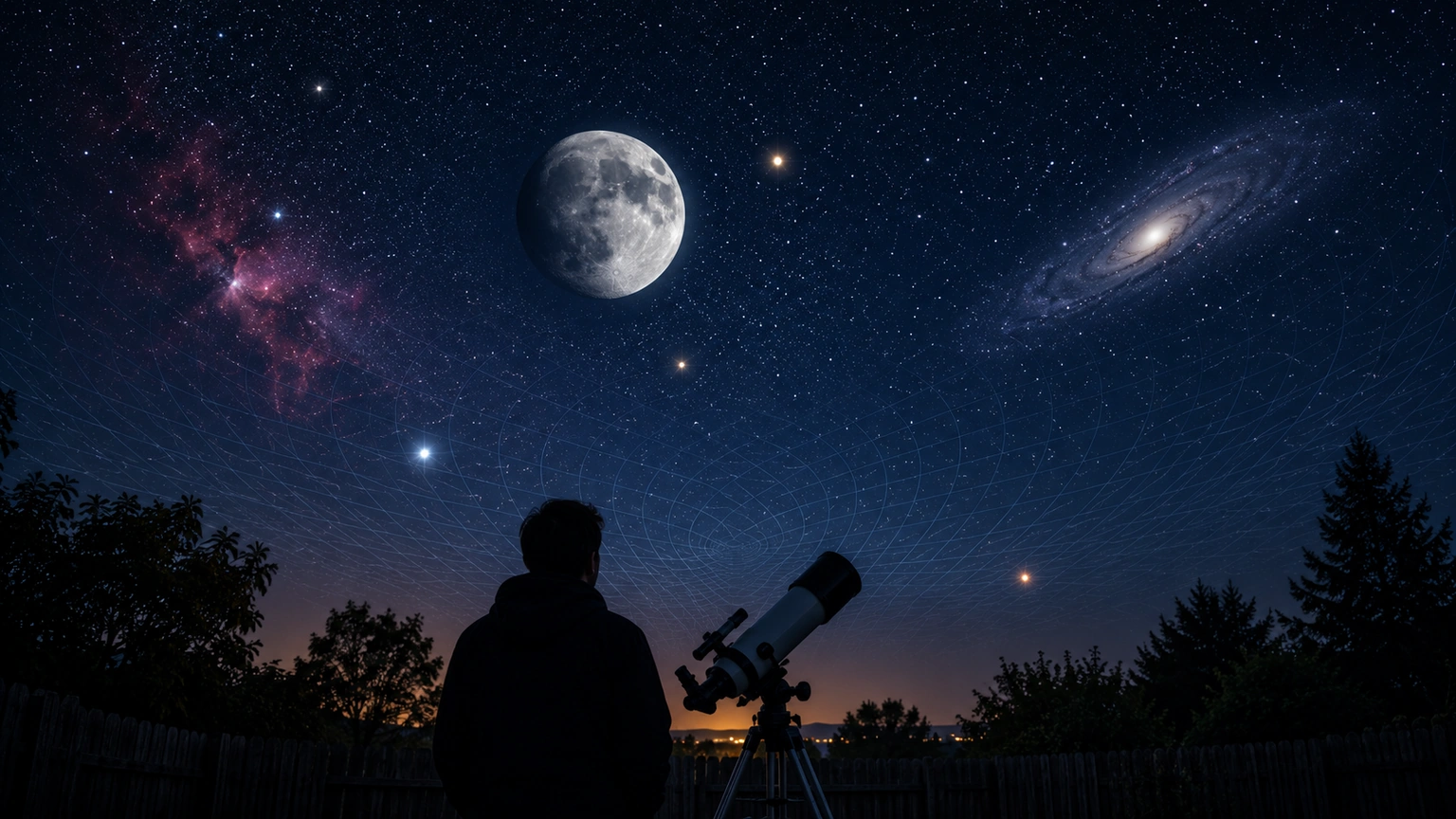
Space can feel intimidating — full of enormous numbers and strange vocabulary. But the core ideas are surprisingly approachable, and a little understanding makes looking up at the night sky far more rewarding. Here is a plain-language tour of the space basics worth knowing, no telescope or physics degree required.
Our cosmic address
It helps to start with where we are. Earth is one of eight planets orbiting the Sun, our nearest star. The Sun and everything bound to it by gravity — planets, moons, asteroids, and comets — make up the solar system. The solar system, in turn, sits within the Milky Way, a vast galaxy of hundreds of billions of stars. And the Milky Way is just one of countless galaxies in the observable universe.
That faint band of light you can sometimes see stretching across a truly dark sky is the combined glow of distant stars in our own galaxy.
The solar system in brief
The Sun
The Sun is a star — a giant ball of hot gas — and it sits at the centre of the solar system. Its gravity holds the planets in their orbits, and its light and heat make life on Earth possible. It is so large that more than a million Earths could fit inside it.
The planets
The eight planets, in order from the Sun, are Mercury, Venus, Earth, Mars, Jupiter, Saturn, Uranus, and Neptune. The four closest are small and rocky; the four outer ones are far larger 'gas giants' and 'ice giants', made mostly of gas and ice. Jupiter is the biggest of all — so large that every other planet could fit inside it with room to spare.
Moons, asteroids, and comets
Many planets have moons — natural satellites held in orbit by gravity. Earth has one (the Moon); Jupiter and Saturn have dozens each. Asteroids are rocky leftovers from the solar system's formation, most found in a belt between Mars and Jupiter. Comets are icy bodies that grow glowing tails when they swing close to the Sun.
Measuring the unimaginable: the light-year
Space is so vast that ordinary units like kilometres become unwieldy, so astronomers use the light-year — the distance light travels in one year, about 9.5 trillion kilometres. Despite the word 'year', a light-year measures distance, not time.
Because light takes time to travel, looking into space is also looking into the past. Sunlight takes about eight minutes to reach us, so we always see the Sun as it was eight minutes ago. The light from distant stars may have set out thousands of years before it reaches your eyes.
Why the Moon matters
The Moon is Earth's only natural satellite and the only other world humans have walked on. Its gravitational pull is the main cause of ocean tides, gently tugging the seas as it orbits. The Moon does not produce its own light — it shines by reflecting sunlight, and the changing angle between the Sun, Earth, and Moon is what gives us the lunar phases, from new moon to full moon.
Gravity: the force that holds it all together
Gravity is the invisible force that keeps the planets circling the Sun and the Moon circling Earth. Every object with mass pulls on every other object; the more massive something is, the stronger its pull. The Sun's enormous mass is what holds the whole solar system together. It is the same force that makes a dropped object fall to the ground.
How to start exploring the night sky
You do not need equipment to begin. On a clear night, away from bright city lights, you can already see stars and planets, and the Moon's craters become clearer with a simple pair of binoculars. Free stargazing apps can help you identify what you are looking at. Start by finding the Moon and the brightest planets, and build from there.
The bottom line
The universe is huge, but its basic vocabulary is friendly once you meet it: a star at the centre, planets and moons held by gravity, distances measured in light-years, and a galaxy full of more stars than we can count. Ready to test what you know? Try our Space and Astronomy Basics quiz, or explore the world below your feet with our Geography Basics quiz.