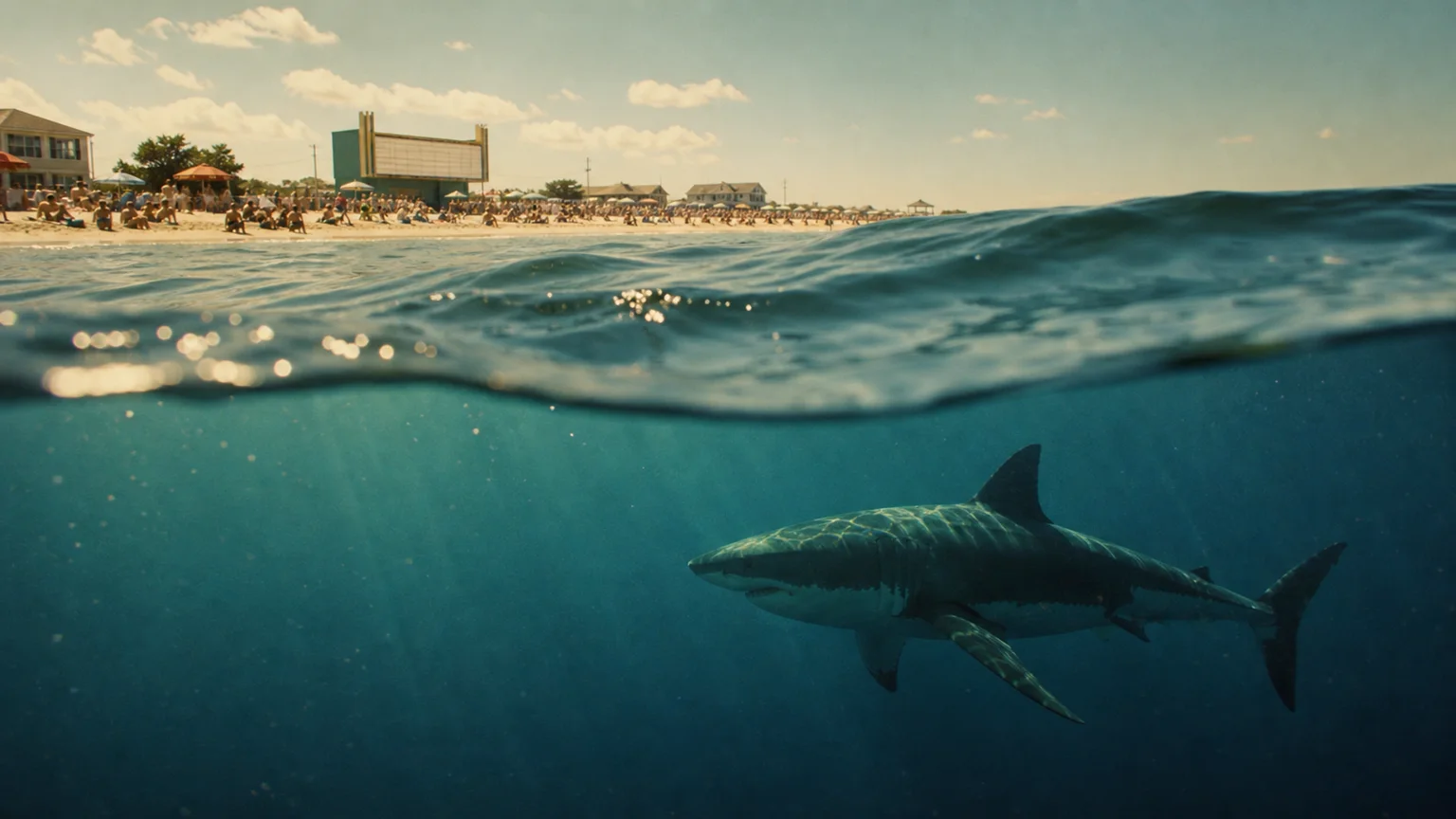
Calling Jaws “the first blockbuster” is memorable but too simple. Spectacular films and enormous box-office hits existed long before 1975. What the evidence supports is narrower and more useful: Jaws became a key prototype of the modern summer blockbuster, combining an easy-to-communicate premise, an event-style television campaign, rapid nationwide success, a June release, and filmmaking strong enough to sustain audience interest.
That distinction matters because “blockbuster” can describe several things: a very popular film, a record-setting gross, a large production, a release strategy, or an industry model built around a few heavily promoted events. Jaws was not first under every definition. It was a turning point in how these elements worked together and what studios expected a major release to achieve.
Establish the dated facts first
The American Film Institute Catalog records these basic facts:
- Jaws opened in New York and Los Angeles on 20 June 1975.
- It earned $25.7 million in nationwide receipts during its first 13 days, according to a contemporary report cited by AFI.
- By September 1975, trade reports described it as the most successful motion picture in U.S. and Canadian industry history, passing The Godfather.
- By May 1977, it had reached $200 million in worldwide receipts, under the measure reported by AFI.
- AFI says many film historians view Jaws, together with Star Wars in 1977, as helping establish the precedent for launching high-potential action-adventure films at the start of the summer holidays.
The Library of Congress National Film Registry essay uses a different figure: more than $260 million in the initial domestic release. Historical box-office figures can differ because sources may count rentals versus grosses, initial engagements versus later runs, or domestic territories differently. The safest conclusion does not depend on forcing those totals into one number: contemporary evidence shows an unusually fast opening and record-level commercial performance.
The claim Jaws did not earn: “the first hit movie”
Earlier films had already attracted mass audiences and generated remarkable revenue. Roadshow spectacles, biblical epics, musicals, war films, disaster pictures, and films such as Gone with the Wind, The Sound of Music, The Godfather, The Exorcist, and The Sting complicate any claim that a hit of this scale had no precedent. Jaws also did not invent sequels, merchandising, summer screenings, television advertising, or broad release patterns.
Film history rarely turns on one clean first. A practice may exist in limited form, then appear in a more visible combination, then become an industry norm after later successes. Treating Jaws as a prototype acknowledges earlier hits while still explaining why 1975 became a reference point.
The premise could be sold in seconds
A shark threatens a beach town during the season on which the town's economy depends. That sentence contains the threat, place, clock, and conflict. Audiences did not need a long explanation to understand the experience being offered.
Peter Benchley's bestselling novel had already introduced the story to readers. Roger Kastel's image for the paperback—an enormous shark rising beneath a swimmer—gave the campaign a stark visual identity. The title, image, danger, and John Williams's two-note musical idea could be repeated across television spots, print advertising, publicity, and theatre displays.
This is often called a high-concept quality: the core appeal is quickly communicated. The phrase should not imply that the finished film is simple. It explains why the campaign could create recognition across many markets at once.
Television turned the release into a shared event
The National Film Registry essay says the film was sold as an event and describes its campaign as among the first to saturate television with advertising. By 1975 television was already a mature household medium—the television adoption timeline shows how rapidly ownership expanded in the 1950s. A coordinated television campaign could therefore build awareness beyond readers of the novel or regular cinema audiences.
The important innovation was not “the first TV ad for a movie.” It was the scale and integration of the campaign with a release designed to convert widespread awareness into attendance quickly. Viewers in different markets encountered the same recognisable threat before opening. Early commercial success then became news and conversation, reinforcing the event.
This model suited studios seeking a large result in a short period. Advertising became less about patiently supporting a film as it travelled and more about concentrating attention around the opening. Not every later film copied the exact tactics, but the underlying logic became familiar.
June became part of the story
The 20 June opening aligned the film with its subject: beaches, holiday travel, swimming, and a fictional resort trying to protect its summer business. That seasonal fit made the campaign unusually immediate.
It would be wrong to say that people did not attend films in summer before Jaws. The stronger claim is that its record performance helped change studio beliefs about the season. AFI connects Jaws and Star Wars to a precedent for positioning high-potential action-adventure films at the beginning of summer holidays. A date once considered less prestigious than major holiday or awards periods could anchor a studio's commercial calendar.
The modern “summer movie season” was not completed in one weekend. It emerged as studios repeated and expanded the lesson through later event films.
The campaign generated attention; the craft sustained it
Marketing explains why audiences know a film is opening. It does not fully explain why a movie remains influential for five decades. The Academy of Motion Picture Arts and Sciences calls Jaws often considered the first modern summer blockbuster, but its collection material also emphasises how production problems generated creative solutions.
The mechanical sharks malfunctioned frequently during filming. Spielberg and his collaborators often suggested the animal through underwater point-of-view shots, a moving barrel, reactions, editing, and music rather than showing it clearly. The Library of Congress essay argues that those constraints improved the filmmaking.
Several craft elements work together:
- John Williams's score signals an approaching threat even when the animal is unseen.
- Verna Fields's editing controls the timing of information and shock.
- Bill Butler's photography places the audience near water level and inside subjective movement.
- Spielberg's staging moves between public space, family life, local politics, and the confined Orca.
- The performances give the premise competing human perspectives: Brody's responsibility and fear, Hooper's expertise, Quint's experience, and the mayor's economic pressure.
AFI records Academy Awards for editing, original dramatic score, and sound, plus a Best Picture nomination. Those honours do not prove commercial influence, but they show that the film's success was not only an advertising achievement.
It connected New Hollywood tension with mass spectacle
The Library of Congress essay calls Jaws a bridge between the cynicism and moral complexity associated with New Hollywood and the populist thrills that became prominent afterward. That description helps explain why the film does more than deliver shark attacks.
Amity's leaders face a conflict between acknowledging danger and protecting the tourist economy. Brody is an authority figure who cannot simply make the system act. Quint's Indianapolis speech gives the hunt a history of trauma. The story contains distrust, institutional failure, and flawed judgment alongside suspense and release.
The film therefore offered a repeatable commercial surface without discarding character and ambiguity. Later blockbuster strategy could copy the visible components—a clear premise, spectacle, campaign, season, and fast revenue—without always reproducing the same balance of craft and tension.
The box-office lesson changed studio expectations
A record hit does not mechanically command an industry, but it changes the examples executives can point to. Jaws showed that a studio could coordinate a recognisable concept, mass-media campaign, summer date, and rapid audience turnout at exceptional scale. Star Wars then extended the event-film model through repeat viewing, licensing, merchandising, and franchise potential.
The Library of Congress essay argues that the revenues of Jaws reconfigured norms of Hollywood success and that later spectacle films increasingly consumed studio resources and attention. This is an interpretation, not a single statistic, but it identifies a real trade-off. Event films can finance ambitious filmmaking and create shared cultural moments; concentrating budgets, screens, and advertising around a few expected hits can also make other kinds of films harder to fund or exhibit.
The legacy is therefore both artistic and industrial. A discussion limited to “people liked the shark movie” misses why the case remains part of film-business history.
A claim-by-claim evidence check
Use this compact test when the “first blockbuster” claim appears:
- Was Jaws the first commercially successful film? No. Many earlier films were major hits.
- Was it the first summer release? No. Its importance is how success changed expectations for summer event releases.
- Did it invent movie advertising on television? No. The significant point is the scale and coordinated event strategy described by the Registry essay.
- Did it produce record results quickly? Yes. AFI cites $25.7 million in nationwide receipts in the first 13 days and later record status.
- Did it act alone? No. AFI explicitly pairs it with Star Wars in establishing an industry precedent.
- Is “prototype of the modern summer blockbuster” defensible? Yes. The Library of Congress uses “prototypical summer blockbuster,” while the Academy says it is often considered the first modern summer blockbuster.
This wording preserves the meaningful argument without erasing earlier cinema or pretending one movie instantly rewrote every release plan.
Why Jaws is still popular
The business case explains why Hollywood studied Jaws; the filmmaking explains why audiences still study and enjoy it. Its threat is simple enough to understand immediately, but its suspense depends on withholding. Its conflicts are specific to one community yet broadly recognisable: expertise versus denial, public safety versus economic pressure, fear versus responsibility. Its music and images remain easy to recall.
Marketing may secure initial attention. Lasting popularity requires that later viewers find something in the film after the campaign has become history. The National Film Registry selected Jaws in 2001, recognising its cultural, historical, or aesthetic significance under the Registry programme.
Frequently asked questions
Was Jaws really the first blockbuster? Not if blockbuster means the first enormous hit. It is more accurately described as a prototype or key case of the modern summer blockbuster.
When was Jaws released? AFI records New York and Los Angeles openings on 20 June 1975.
What box-office evidence supports its influence? AFI cites $25.7 million in nationwide receipts during the first 13 days and reports that it passed The Godfather as the industry's most successful U.S.-Canadian film by September 1975. Historical totals vary by accounting definition.
Did television advertising make the film successful? It helped create rapid, widespread awareness, but the film's suspense, editing, sound, music, performances, reviews, and word of mouth also mattered.
What changed after Jaws? Together with later films including Star Wars, it strengthened the model of launching heavily promoted, broadly accessible action-adventure events near the start of summer.
Place the case in the wider Film History Basics guide, then use the Film History Quiz to check the surrounding milestones. Compare cinema's campaign environment with When Did Television Become Popular?, or browse the entertainment collection.
Put this guide to work
Recommended next step Check the wider film-history timeline Use the quiz to place Jaws among earlier spectacles, sound, colour, studio systems, and later distribution changes.Sources and further reading
- Jaws AFI Catalog of Feature Films · Accessed August 14, 2026
- Jaws (1975): National Film Registry Essay Library of Congress · Accessed August 14, 2026
- Jaws collection highlights Academy of Motion Picture Arts and Sciences · Accessed August 14, 2026
- National Film Registry Library of Congress · Accessed August 14, 2026