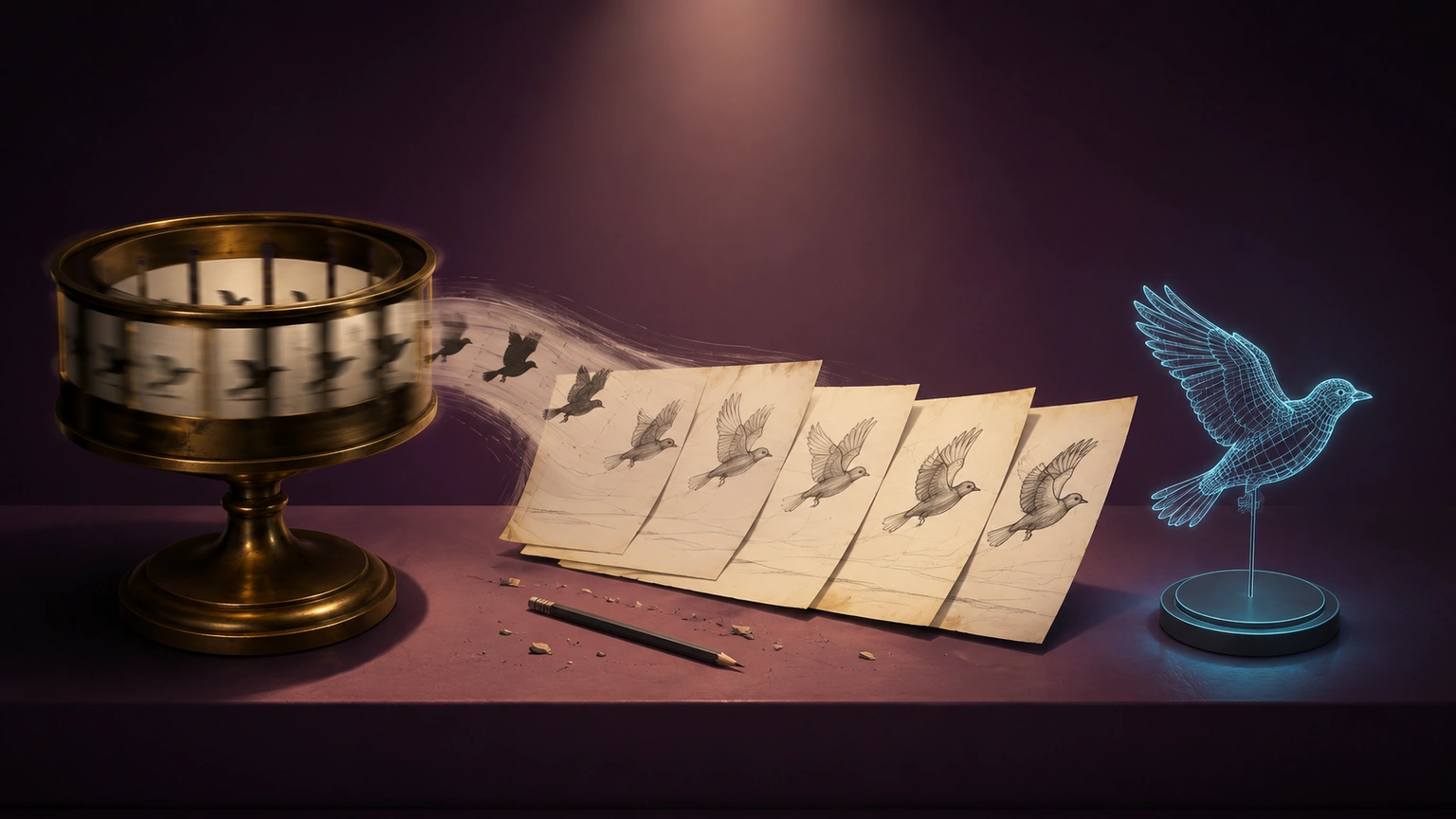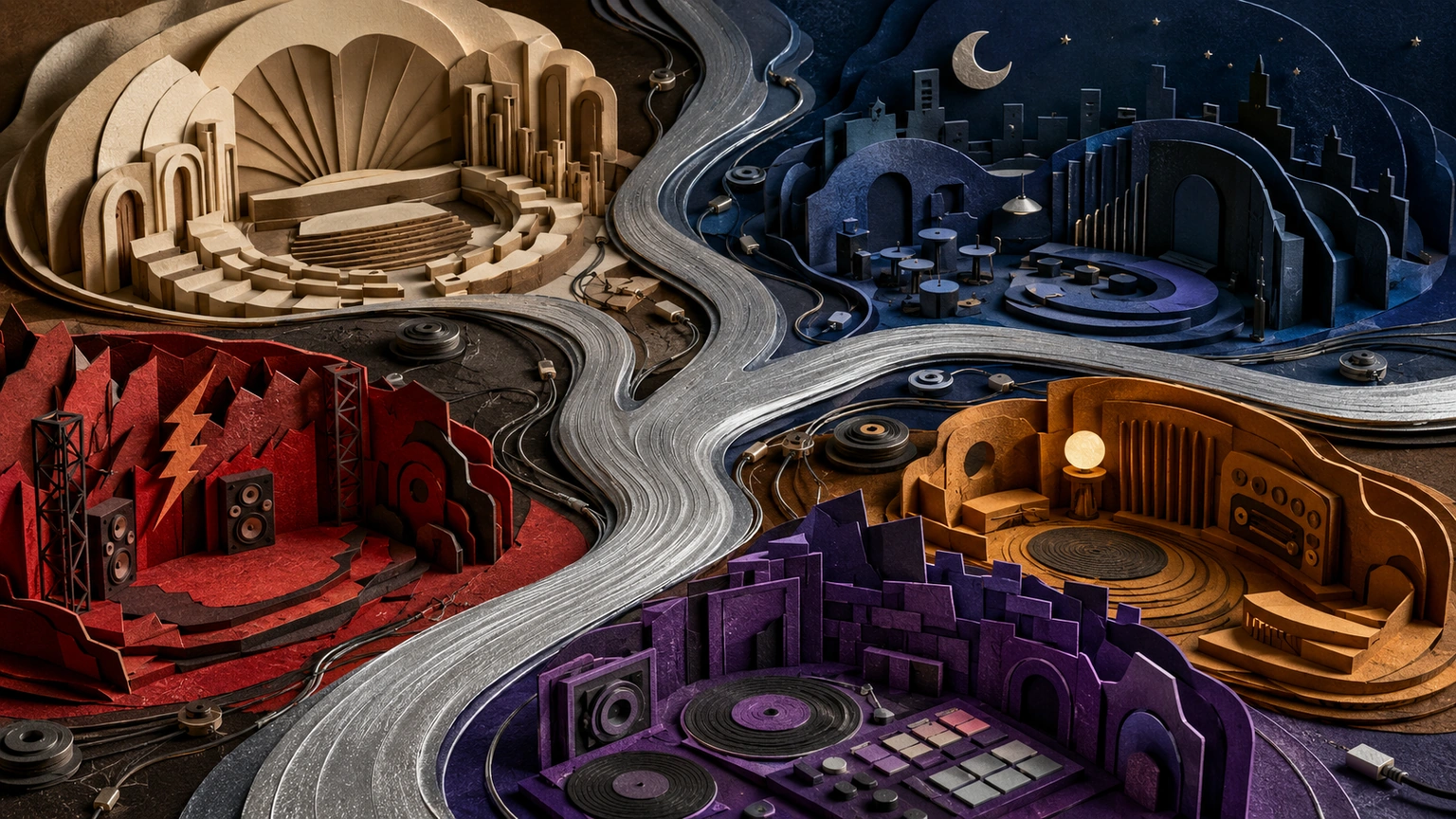
The history of music genres is the story of styles borrowing from one another, splitting apart, and being carried to new audiences by new technology. Most popular genres today can be traced back through a family tree in which the blues feeds jazz and rock, gospel feeds soul, and each new recording format — the phonograph, radio, the LP, the MP3 — widens who gets to hear what. You do not need to read music to follow that story; you only need to notice which older sound each new genre was reacting to.
This guide is a viewing map rather than a complete catalog. Music developed across many cultures at once, and no short article can cover every tradition. The aim here is to give you the main branches and the connections between them.
Before genres: notation and the classical eras
For most of history, music lived only in the moment it was performed. That changed as Western musicians developed notation — a written system for pitch and rhythm. An 11th-century monk, Guido of Arezzo, refined the staff of lines and spaces and the singing syllables that became 'do-re-mi,' letting performers learn music from a page instead of only by ear.
Written music made large, complex works possible. The Baroque era (roughly 1600–1750) produced opera — drama sung throughout — along with the concerto and richly layered harmony. The Classical era that followed favored balance and clarity, with Haydn and Mozart shaping the symphony. Beethoven then pushed music toward the emotional, personal expression of the Romantic era, composing some of his greatest works after losing much of his hearing. These 'classical' periods are not one genre but several, and they established ideas about melody, harmony, and form that later popular music would both use and rebel against.
Recording changed everything
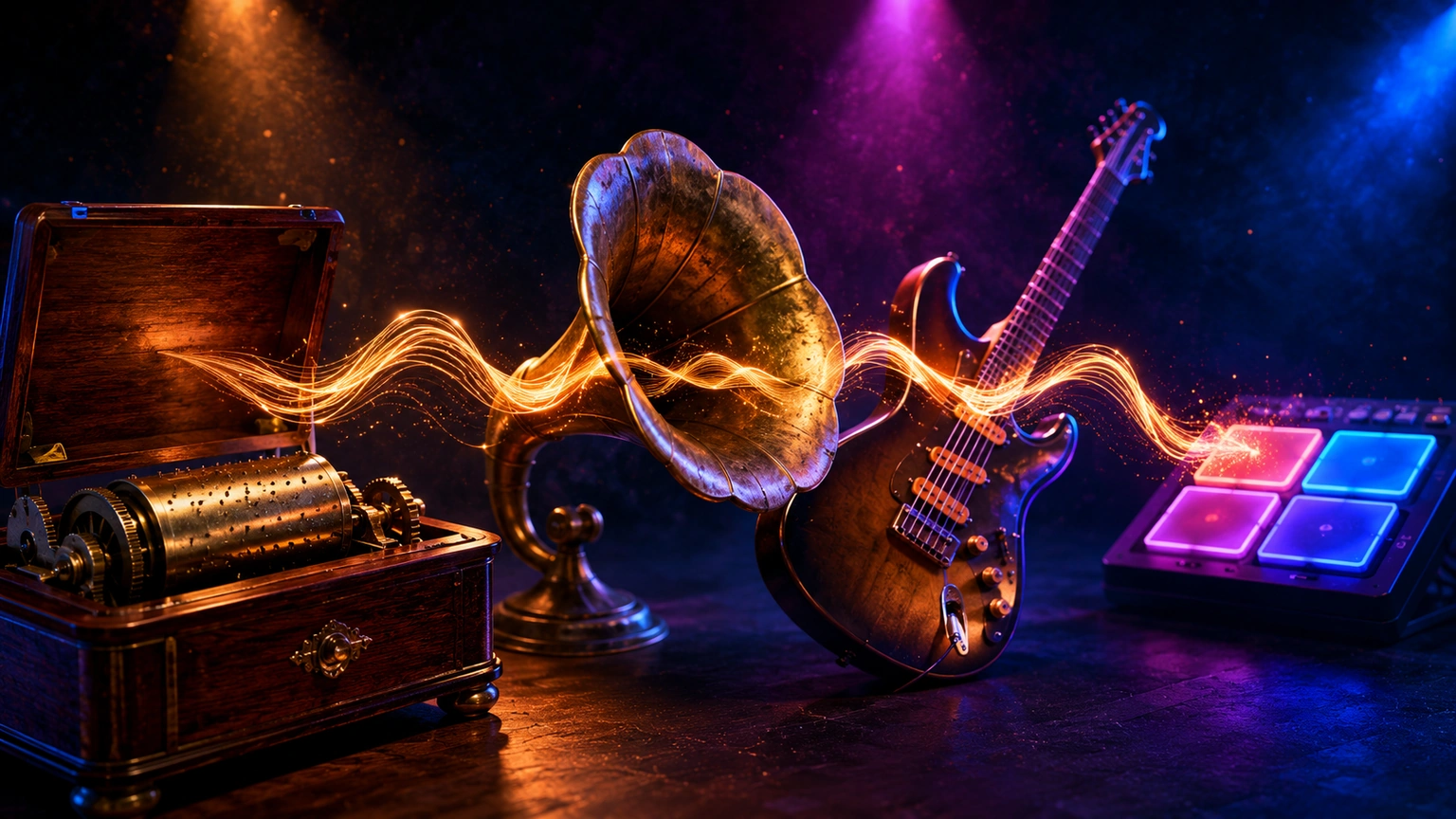
The single most important event in the history of genres was not a style at all — it was a machine. Thomas Edison's phonograph (1877) was the first device that could record sound and play it back. For the first time, a performance could be captured and sold, and a listener in one town could hear a musician from another.
Recording and, soon after, radio meant that regional styles no longer stayed regional. A sound born in one community could reach the whole country within months. Almost every genre that follows in this article spread because it could be pressed onto a disc and broadcast over the air.
The blues: a root system
In the African American communities of the American South, work songs, field hollers, and spirituals combined in the late 19th and early 20th centuries into the blues. Its 12-bar chord pattern and expressive 'blue' notes gave it a flexible, deeply human sound.
The blues matters far beyond its own recordings because it became a root system for other genres. Its structure and feeling run through jazz, rhythm and blues, rock and roll, and much of what came after. If you understand the blues, you understand the DNA of most American popular music.
Want to test the milestones as you go? Try the Music History Quiz — ten quick questions with an explanation after every answer.
Jazz and the sound of improvisation
Around the turn of the 20th century, jazz grew out of a mix of blues, ragtime, brass-band music, and other traditions, with New Orleans widely credited as an early cradle. Its defining feature was improvisation: musicians inventing melodies in the moment over shared chord changes.
Jazz evolved quickly — from the hot New Orleans style to the danceable big bands of the swing era, to the fast, harmonically adventurous bebop of the 1940s, and onward to cool jazz and fusion. Along the way it became one of America's most influential exports and a proving ground for instrumental virtuosity.
Rock and roll: a collision of styles
In the 1950s, rock and roll emerged from a collision of African American rhythm and blues with country music, amplified by the electric guitar and a driving backbeat. It was loud, danceable, and aimed squarely at a new postwar youth audience.
Rock did not stay still. In the 1960s and 70s it branched into folk rock, psychedelic rock, hard rock, and progressive rock, then later into punk, which stripped the music back to fast and raw, and heavy metal, which pushed volume and intensity. Each sub-genre was, in part, a reaction to the one before it — proof that genres often define themselves against their parents.
Soul, funk, and the Motown crossover
Gospel's emotional power flowed into secular music as soul, which married church-rooted singing to rhythm and blues. In Detroit, Berry Gordy founded Motown in 1959 and built a hit factory whose polished, crossover records brought Black artists to a mass national audience during the civil rights era.
From soul came funk, which emphasized rhythm and the groove — tight, syncopated bass and drums over which everything else locked in. Funk's rhythmic focus would become one of the direct building blocks of hip-hop a decade later.
Hip-hop and the age of sampling
In the Bronx in the 1970s, DJs began extending the instrumental 'breaks' of funk and soul records so dancers could keep going, while MCs rapped over the top. This was the birth of hip-hop, a culture that grew from block parties into a global force spanning DJing, MCing, breakdancing, and graffiti.
Hip-hop's signature production technique is sampling — reusing a slice of an existing recording inside a new track. Sampling made the entire recorded past into raw material for new music, tying hip-hop directly back to the funk, soul, and jazz that came before it. By the 21st century, hip-hop had become one of the most commercially dominant genres in the world.
The digital era: MP3s and streaming
The 1990s brought the MP3, a compressed audio format small enough to store many songs on a computer and share them online. MP3 players, file-sharing, and eventually streaming services followed, moving music from a physical product you owned to a library you accessed.
Digital distribution did something subtle to genres: it lowered the cost of both making and sharing music, so niche styles could find audiences without radio or a major label. The neat genre boxes of the radio era grew blurrier as artists mixed influences freely and playlists organized music by mood as much as by category.
How to listen across the family tree
A good way to hear the history is to follow the connections rather than memorize dates. Pick a blues recording, then a jazz piece, then a 1950s rock and roll single, then a Motown hit, then an early hip-hop track. Listen for what each one kept from the last and what it threw out. Genres are less a set of sealed containers than a conversation across generations.
Frequently asked questions
What is the oldest music genre? That depends on how you define a genre. Musical traditions are older than any recording, and 'classical' music covers several eras stretching back centuries. Among widely recognized popular genres, the blues is one of the oldest roots, feeding much of what followed in the 20th century.
What genre influenced the most others? The blues is often described as the root of American popular music, because jazz, rhythm and blues, rock and roll, and — through funk and soul — hip-hop all draw on it. That wide influence is why it appears so often in any music history.
Why do new genres keep appearing? New genres tend to form when musicians react against an existing style, when a new instrument or technology appears, or when different traditions mix in a new place. Each of those happened repeatedly across the last century, which is why the family tree keeps branching.
Do I need to read music to understand music history? No. Notation is useful for performers, but the history of genres is mostly about sounds, technology, and the communities that made them. You can follow the whole story just by listening.
Keep exploring
Ready to check what stuck? Take the Music History Quiz, then branch out with the Animation History Quiz or the Film History Quiz to see how sound and image evolved alongside music.
Sources and further reading
- Music research guide and Grove Music Online Library of Congress · Accessed July 22, 2026
- History of the Cylinder Phonograph Library of Congress · Accessed July 22, 2026