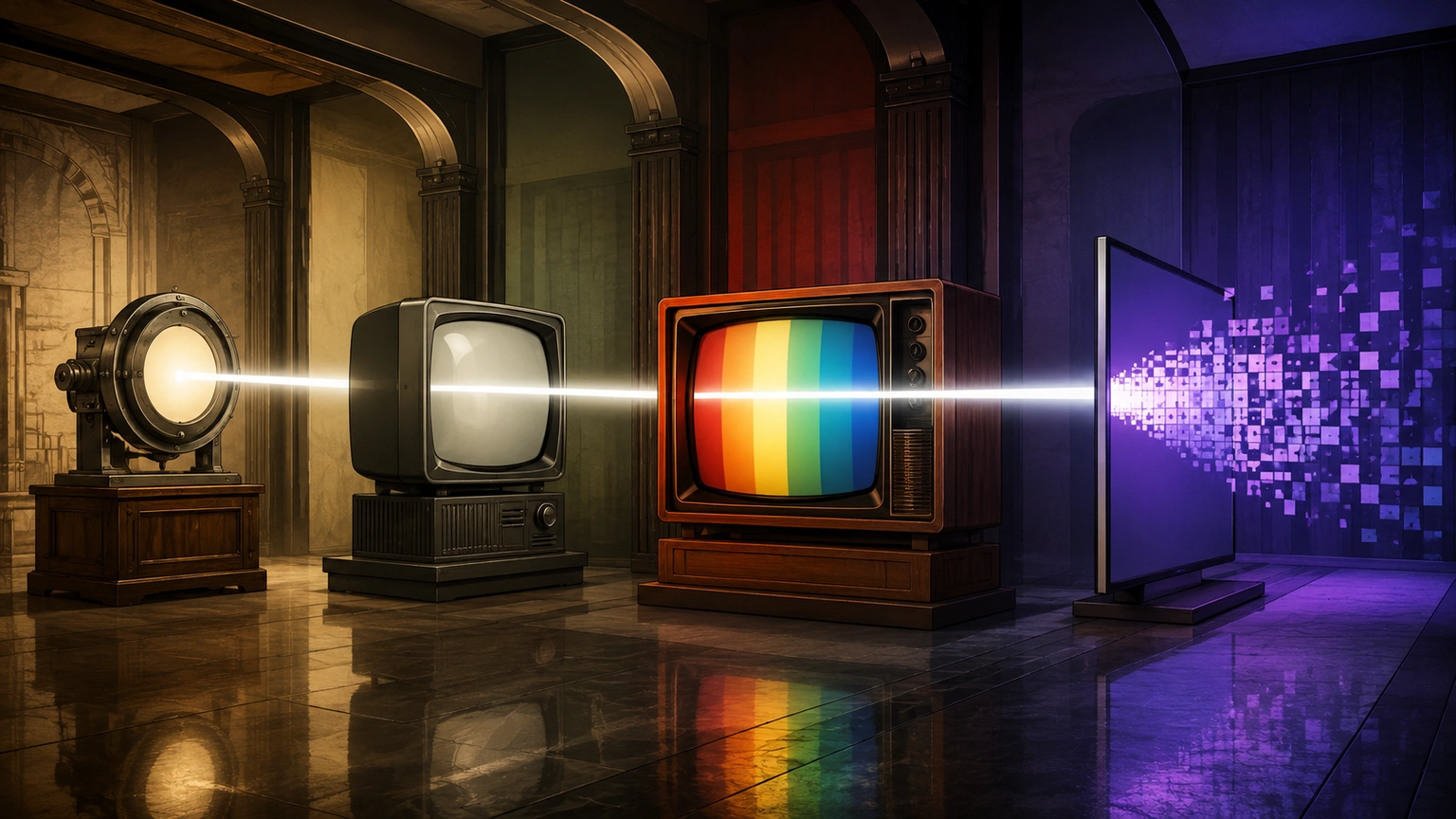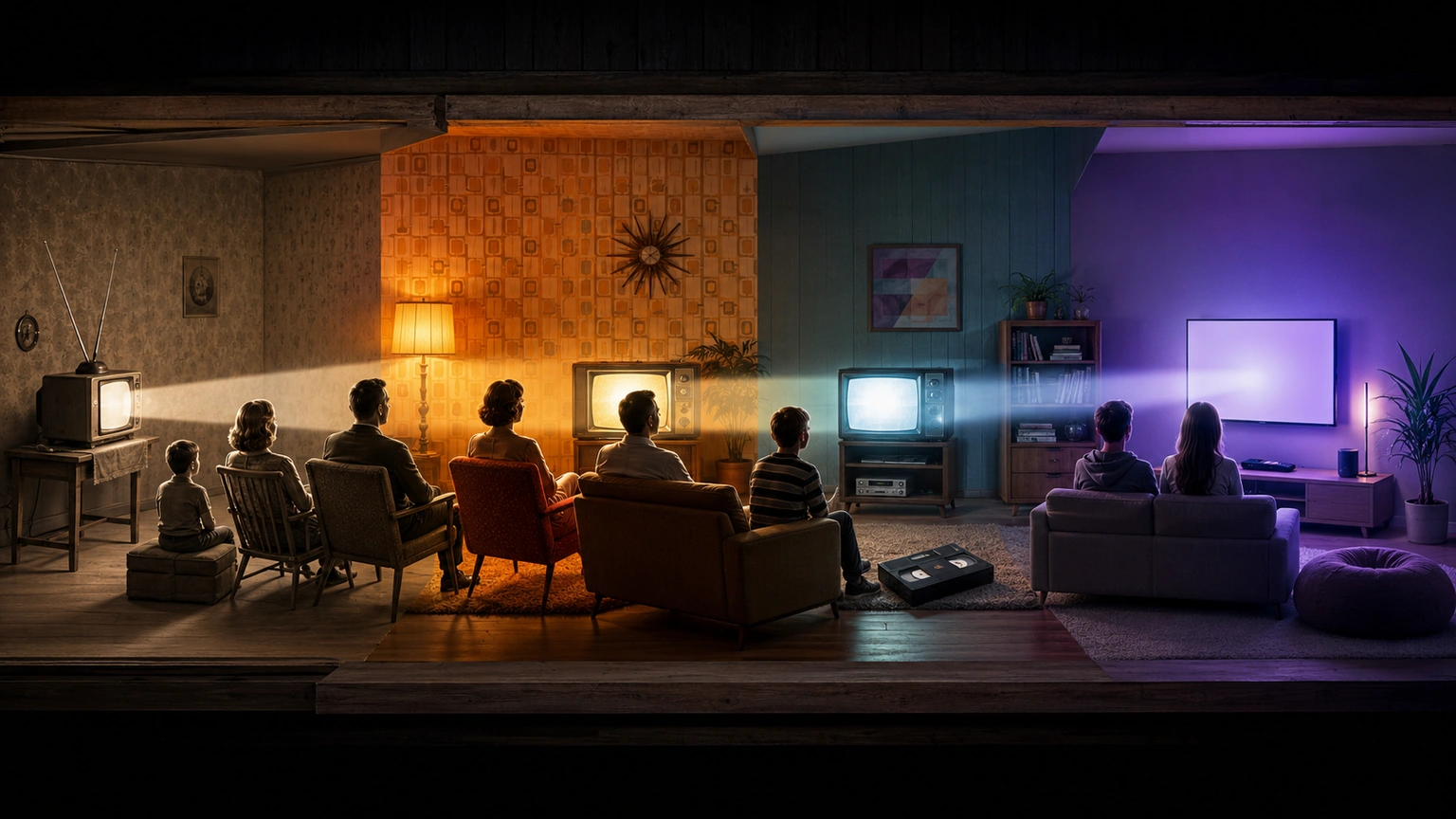
Television became popular as a household medium in the late 1940s and especially the 1950s—not when it was first invented. In the United States, the 1950 Census counted about 5 million television households. By 1960, more than 46 million of 53 million occupied housing units had at least one set. In Britain, the 1953 coronation of Queen Elizabeth II drew more than 20 million viewers and helped establish television as a shared national medium.
That answer needs boundaries. Television did not have one inventor, launch date, or worldwide adoption curve. Experiments occurred in several countries; broadcast services developed under different institutions; war interrupted some of them; and access varied by region and income. This annotated timeline separates four questions that short histories often blend together:
- When could a picture be transmitted?
- When did scheduled broadcasting exist?
- When could ordinary consumers buy usable sets?
- When did television become common enough to reshape household routines and mass culture?
Before television was popular: mechanical experiments in the 1920s
Early television systems converted an image into a signal and reconstructed it elsewhere. Some used spinning, perforated discs to scan an image mechanically. The Smithsonian's National Museum of American History notes that Charles Francis Jenkins's Radiovisor reached a limited U.S. market in the late 1920s; John Logie Baird independently developed mechanical television in Britain. These machines worked, but their small, coarse pictures and high costs did not make television a mass household product.
The Science Museum records that the BBC experimented with Baird's 30-line system in 1929 and used it for a television service launched in 1932. This was a broadcasting milestone, but “a service exists” is not the same as “most homes use it.” Coverage, programming, receivers, and picture quality were all limited.
Why this stage matters: it proved that moving images could be broadcast, while also showing why a technically functioning system may remain a specialist novelty.
1927–1928: electronic television becomes practical
Electronic scanning removed the spinning disc and pointed toward the form television would take for decades. Philo Farnsworth transmitted an electronic image in his San Francisco laboratory in 1927 and demonstrated his system to reporters in September 1928. Vladimir Zworykin and teams connected with RCA also developed key electronic camera and receiver technology. Patent disputes later encouraged simplified “one inventor” stories, but television emerged from overlapping work in imaging, radio, electronics, manufacturing, and broadcasting.
The U.S. Census Bureau's history of Farnsworth makes the adoption gap clear: his demonstration preceded widespread ownership by decades. An invention date establishes technical possibility, not popularity.
Why this stage matters: electronic systems offered a path to more reliable, higher-quality pictures, but a home medium still required standards, transmitters, programmes, factories, retailers, and buyers.
1936–1939: scheduled services and public demonstrations
Britain developed regular broadcasting during the 1930s, while U.S. broadcasters continued experiments. In 1939, NBC televised the opening ceremonies of the New York World's Fair. RCA also introduced an electronic receiver to the public at the fair and offered sets for sale. Franklin D. Roosevelt's appearance in the opening programme helped present television as a technology of public events rather than only a laboratory device.
The World's Fair demonstration was important marketing, but its audience was concentrated around the small number of transmitters and sets. A visitor seeing a working receiver in 1939 should not be confused with a family owning one in 1955.
Why this stage matters: television became publicly legible. People could see a product, a broadcast, and a possible future—even though the network and household scale had not arrived.
1939–1945: war interrupts consumer expansion
World War II complicates any smooth “invention to adoption” timeline. Manufacturing capacity, electronics research, and materials were directed toward military needs. Broadcast development did not vanish everywhere, but consumer production and network growth were constrained. The Smithsonian American Art Museum estimates that during the war only about 40,000 television sets were in use in the United States, mostly around New York, where stations were concentrated.
The war also advanced electronics and trained technical workers, creating knowledge that could support postwar production. Yet the immediate effect for households was delay: a technology demonstrated before the war did not become an ordinary consumer object during it.
Why this stage matters: history was not a steady sequence of better inventions. Institutions, manufacturing priorities, and a world conflict shaped when people could actually adopt television.
1946–1949: the postwar market takes off
After the war, manufacturers resumed consumer production, stations multiplied, and network schedules became more attractive. Returning prosperity, new household formation, advertising, and established radio performers helped television find both buyers and programmes. The medium borrowed formats and talent from radio while adding the draw of a live picture.
Adoption was uneven. Early stations clustered in cities, and sets remained a major purchase. Families without receivers could watch in shop windows, bars, or neighbours' homes, so audience reach grew faster than ownership alone suggests. The Smithsonian estimates that the number of U.S. sets rose to around 10 million by the end of the 1940s.
National events helped demonstrate value. President Harry Truman's 1949 inauguration was the first televised nationally. Sports, variety, news, children's programmes, comedy, and drama gave households repeated reasons to use the set rather than admire it as a novelty.
Why this stage matters: television acquired the reinforcing parts of a medium—equipment, stations, national connections, regular programming, advertising revenue, and social occasions built around viewing.
1950: popular, but not yet universal
The 1950 Census offers a strong checkpoint because it asked about television ownership. About 5.03 million of more than 42 million reporting households owned a set—roughly 12%. Nearly 4.4 million television households were urban, while only about 154,000 farms reported a set.
Those numbers support two conclusions at once. Television was plainly an established commercial and cultural phenomenon by 1950, but it had not yet reached most households. Geography and transmitter coverage mattered. Calling 1950 “the television age” describes momentum and influence, not universal access.
Why this stage matters: it replaces vague memories with a measured adoption point and reveals the urban-rural divide hidden inside a national total.
1950–1955: the decisive mass-adoption years
The steepest part of the U.S. household curve came early in the decade. Census Bureau historical summaries place ownership at about 9% of households in 1950 and 65% in 1955. Popular schedules gave owners something dependable to watch, while expanded transmission and mass manufacturing made ownership practical in more places.
Television also became furniture and a social centre. The National Museum of American History describes consumers making it the centrepiece of the 1950s home. Food, seating, room layouts, advertising, and evening routines adapted around the screen. This is a stronger meaning of “popular” than sales alone: other products and habits began assuming television's presence.
Programme forms matured as well. Live broadcasts remained important, but filmed production made preservation, repeat broadcasts, and syndication easier. Networks and sponsors could address large audiences at once. Shared viewing created national reference points, even while access and representation remained unequal.
Why this stage matters: by mid-decade, television had crossed from a growing product into a mass medium in the United States.
1953 in Britain: the coronation as an adoption event
Britain's curve followed a different institutional path, making 1953 a useful comparison. The Science Museum reports that manufacturers promoted sets heavily before Queen Elizabeth II's coronation; about 2.5 million sets were installed by the broadcast. More than 20 million people watched, with many gathering in homes, pubs, and community centres. Surveys suggested an average of 17 viewers around each set.
The event did not invent British television. The BBC had used Baird's system before the war and expanded transmission after 1945. What the coronation did was make the social value of live television unusually visible: millions could witness the same distant event together.
Why this stage matters: a major programme can accelerate adoption and cultural legitimacy, while group viewing means audience size can greatly exceed the number of receivers.
1960: television is a household norm
By the 1960 Census, more than 46 million of 53 million occupied U.S. housing units reported at least one television—about 87%. Television households outnumbered households with an automobile, telephone, washing machine, or air conditioning. The National Museum of American History rounds the figure to nearly 90%.
This is the clearest answer to “when did television become popular?” in the U.S. context: the transition happened across the 1950s, and by 1960 television was a household norm. By 1970, Census data put ownership at 95.5%, showing continued expansion after the decisive decade.
Why this stage matters: mass adoption is measurable. The change from about 5 million television households in 1950 to more than 46 million in 1960 is not merely a story about famous programmes; it is a transformation in domestic infrastructure.
Colour existed before it became common
Another common mistake is to treat invention, broadcasting, and adoption as one date for colour television. The FCC approved RCA's compatible colour system in December 1953, with broadcasts beginning in 1954. But sets were expensive and much programming remained black-and-white. Smithsonian collection research estimates about 15,000 colour sets in households in 1955 and sales of around 90,000 units by 1959—tiny beside total television ownership.
Colour therefore belongs after the main popularity answer. Black-and-white television had already become a mass medium before colour became a normal household feature.
Why this stage matters: a standard can be approved years before prices, programmes, and replacement cycles make it common.
Why television became popular so quickly
No single programme or inventor explains the 1950s curve. Several systems reinforced one another:
- Manufacturing: postwar factories could produce receivers at consumer scale.
- Coverage: more stations and network links made a set useful outside the first cities.
- Programming: recurring news, comedy, drama, sport, variety, and children's shows built habits.
- Advertising: sponsors financed programming and promoted television as part of consumer life.
- Live events: public occasions made simultaneity valuable.
- Social viewing: one set could serve a family, neighbours, or a public venue.
- Falling practical barriers: availability, reliability, and household willingness improved even while a set remained a significant purchase.
These factors explain why “better technology” is incomplete. A technically impressive receiver without transmission or programming has little household value; a strong schedule cannot reach homes without affordable sets and signals.
How to read television milestones accurately
When you see a “first,” ask what kind it is. The first experiment, public demonstration, scheduled service, commercial sale, national broadcast, majority-household threshold, and colour standard answer different questions. Also ask which country the statement describes.
A useful timeline labels evidence this way:
- Technical milestone: a system can work.
- Institutional milestone: a broadcaster or regulator establishes service or standards.
- Commercial milestone: receivers and programmes form a sustainable market.
- Adoption milestone: measured households own or regularly access the medium.
- Cultural milestone: routines and other industries change around it.
This framework also helps with later changes such as cable, home video, digital broadcasting, and streaming. Each had invention, launch, adoption, and cultural phases rather than one magic date.
Frequently asked questions
When did television become popular in America? During the 1950s. Census sources show about 5 million television households in 1950 and more than 46 million of 53 million occupied housing units with at least one set in 1960.
Was television invented in 1927 or 1928? Farnsworth transmitted an electronic image in 1927 and demonstrated his system to reporters in September 1928. Those are technical milestones, not the start of mass ownership, and other inventors contributed essential work.
Did World War II stop television? It interrupted and redirected consumer expansion, especially manufacturing, rather than erasing every broadcast experiment. U.S. household growth accelerated after the war.
Why was the 1953 coronation important? More than 20 million people watched in Britain, often in groups, demonstrating television's power to create a shared live national experience and encouraging set purchases.
When did colour television become popular? Later than black-and-white television. The U.S. compatible colour standard was approved in 1953, but high set prices and limited colour programming slowed household adoption.
Use the Television History Quiz to check the sequence, then compare cinema's industrial milestones in Film History Basics and the evidence behind the Jaws blockbuster case. Visit the entertainment collection for the wider learning path.
Put this guide to work
Recommended next step Check the television-adoption timeline Use ten explained questions to separate inventions, broadcasts, standards, and household adoption.Sources and further reading
- History and the Census: Philo Farnsworth and the Invention of Television U.S. Census Bureau · Accessed August 14, 2026
- Pay attention to the man on the television screen! Smithsonian National Museum of American History · Accessed August 14, 2026
- Broadcasting Smithsonian National Museum of American History · Accessed August 14, 2026
- Watch This! Revelations in Media Art Smithsonian American Art Museum · Accessed August 14, 2026
- Television reigns: Broadcasting Queen Elizabeth's coronation Science Museum Group · Accessed August 14, 2026
- National Broadcasting Company history files Library of Congress · Accessed August 14, 2026